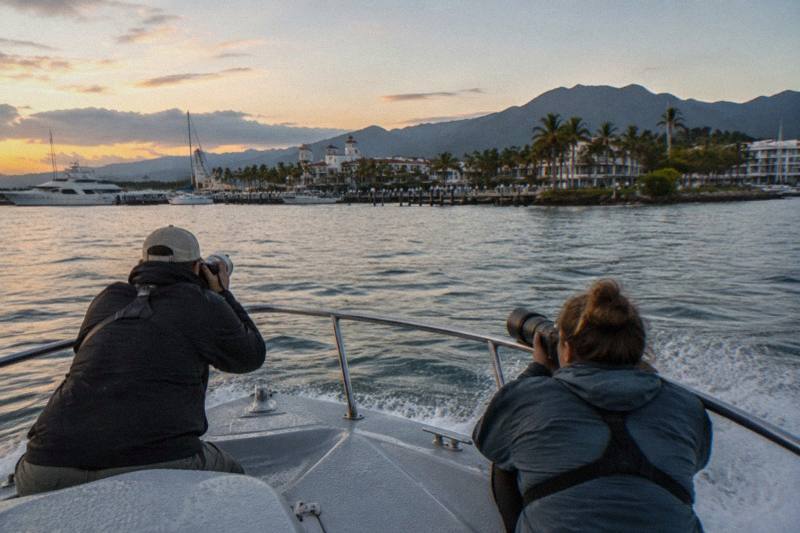
Photographing Humpbacks From A Boat: Settings, Lenses And Timing
Whale watching photography in Banderas Bay rewards preparation more than luck. The right shutter speed, enough lens reach, a morning departure and a boat with open deck space matter more than the camera brand, and the federal approach rules shape every frame you will get.
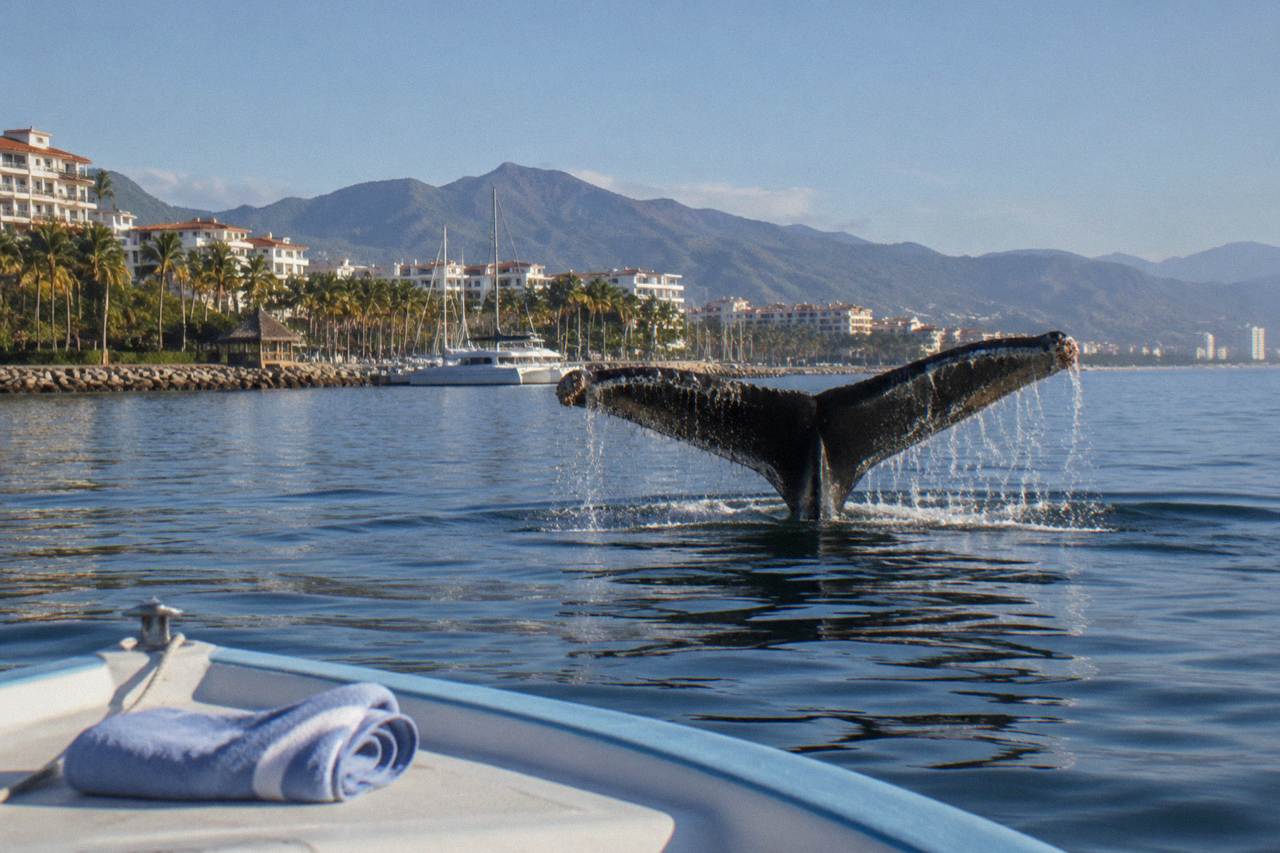
Short answer
Start at 1/1000s shutter, ISO auto, and the longest lens you own, ideally 300mm or more. Morning departures from Marina Vallarta or Nuevo Vallarta give the best light, and small-group boats such as the photo safari from $79 per person give the clearest vantage. Authorised boats keep 60 to 80 m from the whales, so plan your framing around that distance.
Humpbacks reach about 60 ft and about 40 tons, and a full breach lasts roughly two seconds from first splash to last. That gap between scale and time is the whole challenge of whale watching photography: you are shooting a fast, huge animal from a moving platform, usually in morning glare, at a legal distance of at least 60 m. About 500 individual humpbacks visit Banderas Bay each season, according to the local research group ECOBAC, so the subjects are there; the question is whether your camera is ready before the fluke goes up. Learning to read the blows, splashes and surface cues that mean a whale is close gives you a head start on raising the camera before the fluke ever leaves the water.
The boats you choose matter as much as the gear. A biologist-led whale and dolphin boat with 702 reviews, the most reviewed listing on the local roster, and a dedicated small-group photo safari both put fewer elbows between you and the rail than a 60-foot shared cruiser. This guide walks through settings, lens reach, light by time of day, phone technique and the federal rules that decide how close your frame can get, all specific to Banderas Bay, Marina Vallarta, Nuevo Vallarta and the Sayulita departures. Before you book a spot on the water, our guide to Puerto Vallarta safety right now explains which boats are federally authorized, what the life vest rules are, and how hurricane season overlaps the whale season.
What Camera Settings Work For Whale Watching Photography?
Set your shutter to 1/1000s or faster, put the camera in shutter priority or manual, open the aperture to its widest value, and let ISO float on auto. A moving boat adds its own motion to the whale's, so anything slower than 1/800s risks soft flukes and smeared breaches. Shoot in burst mode, continuous autofocus on the whale, and underexpose slightly to hold detail in white pectoral fins and bright sea spray.
The boat's own movement is what kills most whale shots. Even in calm water the deck rises and falls, and at 300mm that translates into visible blur at shutter speeds that would be fine on land. Freeze the whale first at 1/1000s, then relax the speed only if the light forces it. If a humpback is logging, resting motionless at the surface, you can drop to 1/500s and lower ISO for cleaner files.
Exposure is the second battle. A humpback's dark back against sparkling water fools meters into overexposing the water and crushing the whale into black. Dial in one third to two thirds of a stop of negative exposure compensation and check the histogram after the first few frames. The long white pectoral fins of a humpback, the species you will almost certainly photograph here, are the quickest highlight warning you have.
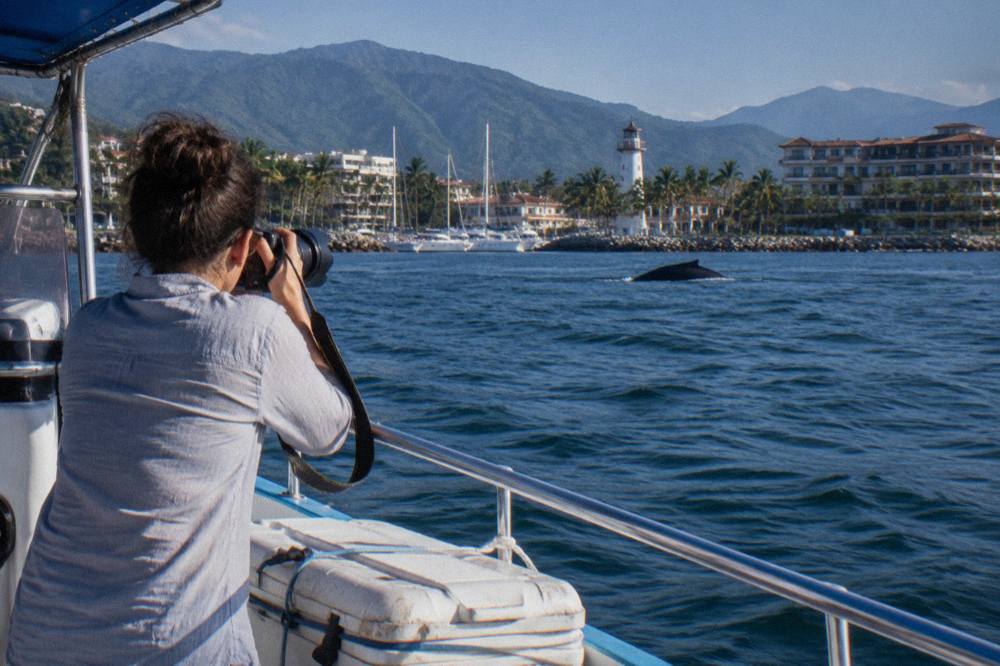
Focus settings deserve one decision made on the dock, not mid-breach. Continuous autofocus with a single expansion point, placed on the whale's body where it meets the water, holds track far better than face detection, which will hunt on spray. If your camera has animal-detection autofocus, test it on the first distant whale before trusting it on a close pass.
| Situation | Shutter | Aperture | ISO | Notes |
|---|---|---|---|---|
| Breach or fluke slap | 1/1000s or faster | Widest available | Auto, allow it to climb | Burst mode, 10+ frames |
| Whale cruising at the surface | 1/1000s | f/5.6 to f/8 | Auto | Track ahead of the blow |
| Logging or resting whale | 1/500s | f/8 | Lower is better | Steady the lens on the rail |
| Distant whale, heat haze | 1/1000s | Widest | Auto | Crop later, do not chase zoom |
| Backlit spray at sunset | 1/1000s or faster | Widest | Auto | Expose for highlights |
How Much Lens Reach Do You Need From A Banderas Bay Boat?
Plan on 300mm effective reach as a realistic minimum, with a telephoto zoom up to 300mm or beyond comfortable for tight fluke and blow shots. Federal rules keep authorised small boats 60 m from humpbacks and larger boats 80 m, so a whale at legal distance fills surprisingly little of the frame at 200mm. A telephoto zoom beats a fast prime here, because whale distance changes constantly.
The approach distances are not operator politeness, they are the federal standard NOM-131-SEMARNAT-2010, which sets 60 m for small boats and 80 m for medium and large boats, with all vessels waiting at 240 m. Photographically, that means you are usually working a subject the length of a bus, framed from two-thirds of a football field away. On a crop-sensor body a zoom lens behaves as if it were longer than its printed focal length, which is why a modest telephoto does respectable work in Banderas Bay.
Bigger whales also let you go wider than you might expect. When a humpback surfaces beside the boat, at the edge of what the rules allow, a 24-70mm or even a phone can capture the whole animal with the bay and mountains behind it. The photographers who come home with the best portfolio from a Marina Vallarta departure usually shot two lenses, long for behavior and wide for context.
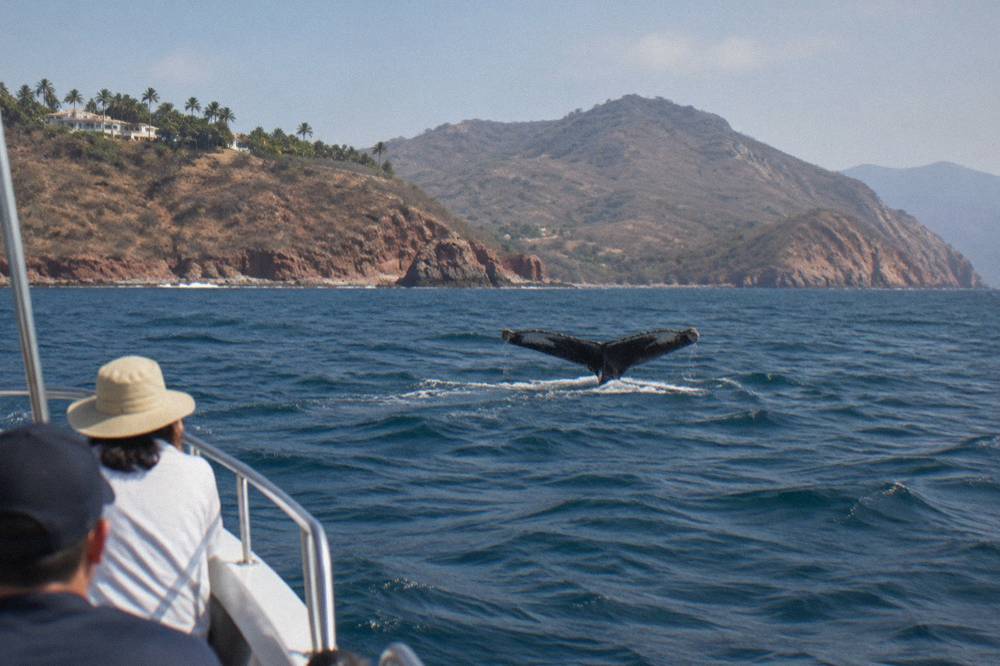
Sensor stabilization helps on the boat, but technique helps more. Rest the lens hood on the rail cushion, tuck your elbows, and rotate your whole torso to pan rather than swinging arms. The small-group half day from Marina Vallarta and the biologist-led 3 hour 30 minute trip from Ecotours Vallarta both run boats where you can move along the rail as the whale shifts side to side, which effectively doubles your reach by letting you shoot the near beam. Your choice of where to sleep also decides which dock you leave from, so the Sayulita versus Puerto Vallarta stay guide is worth reading before you book anything.
| Effective reach | What it gives you in Banderas Bay | Verdict |
|---|---|---|
| 24-70mm | Full whale plus bay, skyline, other guests | Keep it mounted for close passes |
| 70-200mm | Habitat shots, distant blows, dolphin pods | Usable, frustrating for fluke detail |
| Telephoto zoom reaching 300mm | Tight flukes, breaching frames, blow detail | Best single-lens choice for the bay |
| 500-600mm | Frame-filling heads, calf detail at distance | Rewarding but heavy; bring support |
| 1.4x teleconverter | Extra reach at cost of light and sharpness | Worth it only in bright morning sun |
If you are deciding which departure spends your morning best, three boats stand out for photography on the roster, and the comparison below sums up why.
The photo safari, rated 4.7 from 190 reviews and priced from $79 per person, is explicitly built around picture-taking: hydrophones, a light snack and purified water are included, though hotel pickup and drop-off are not. Read more in the wider comparison of Banderas Bay whale tours compared before committing.
When Is The Best Light For Whale Photos In Puerto Vallarta?
Book the earliest morning departure you can. Between about 8 a.m. and 10:30 a.m. the sun is low enough to model the whale's body instead of flattening it, the sea breeze is usually lighter, and the glare off Banderas Bay has not yet peaked. Midday gives harsh top light and blown highlights on spray; late afternoon offers warm color but rising wind chop.
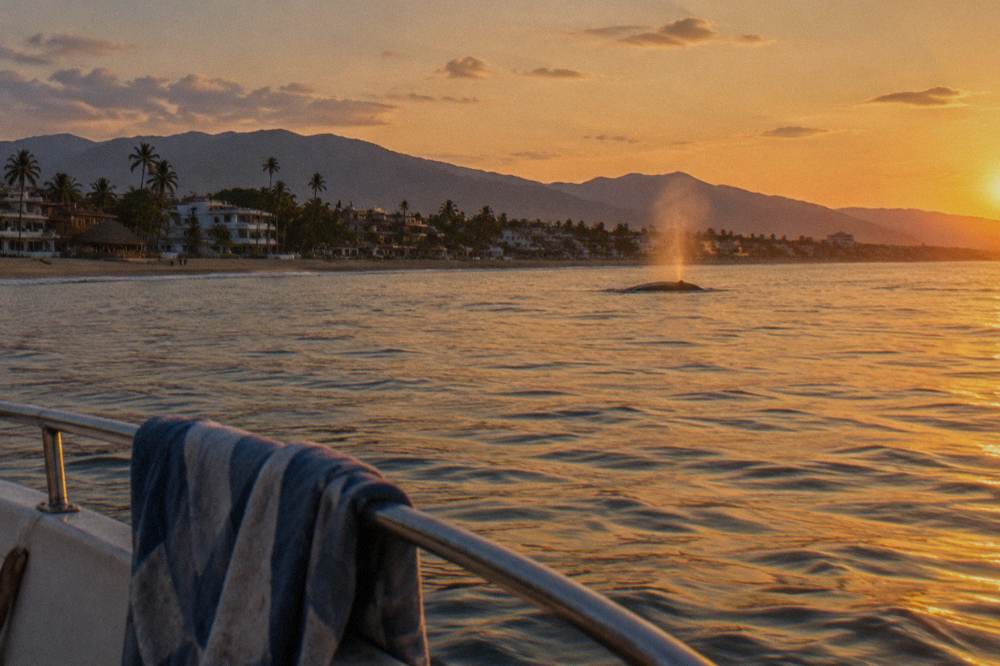
Banderas Bay opens west, so morning light comes across the water from the land side, which puts illumination on the whale's back for boats working the bay's mid-section. The sunrise and whale-watching mega yacht trip from Nuevo Vallarta, rated 4.8 from 517 reviews, exists partly for this reason: a mid-morning slot on the water catches the crossover hour when the light still has direction and the whales are active after the night's feeding lull. Our longer piece on the best time of day to see whales covers the behavior side in depth.
Do not dismiss the last two hours before sunset, especially from December through February, when operators and guides name January and February as the peak months. A humpback pec-slapping into low golden light is the signature image of the bay, and the warm tones carry even on a modest lens. The trade-off is wind: afternoon chop in the open bay makes long-lens framing harder, so raise the shutter speed and brace against the rail.
| Time window | Light character | Sea state tendency | Best subject |
|---|---|---|---|
| 8:00 to 10:30 | Directional, warm, contrasty but manageable | Calmest of the day | Breaches, full flukes |
| 10:30 to 13:00 | High, flat, harsh highlights | Building breeze | Wide habitat shots |
| 13:00 to 16:00 | Neutral, hazy | Afternoon chop | Blow and dorsal shots |
| 16:00 to sunset | Golden, low, dramatic | Chop easing or holding | Pec slaps, backlit spray |

Can A Phone Take Good Whale Photos In Banderas Bay?
Yes, for close passes, breaches near the boat and context shots, but a phone cannot resolve detail at the legal 60 to 80 m viewing distance. Use the main camera, not zoom pinch, lock focus and exposure on the whale, shoot 4K video and pull frames, and rely on burst mode for breaches. A clip-on telephoto attachment helps if the light is good.
The honest physics: digital zoom on a phone interpolates, so a whale that fills a tenth of the screen will stay a smudge no matter how many fingers you spread. Where phones genuinely win is speed. A phone is out of your pocket and shooting in two seconds, while a DSLR user is still flipping a lens cap, and many guests on the whale and dolphin watching trips get their single best breach frame on a phone precisely because it was already running.
Video is the phone's killer feature in whale watching photography. Shoot 4K video, start recording when the whale dives, and extract stills afterwards; a 4K frame makes a high-resolution image, plenty for social and small prints. Turn on the grid, expose down on the water by dragging the exposure slider, and hold the phone with both elbows on the rail.
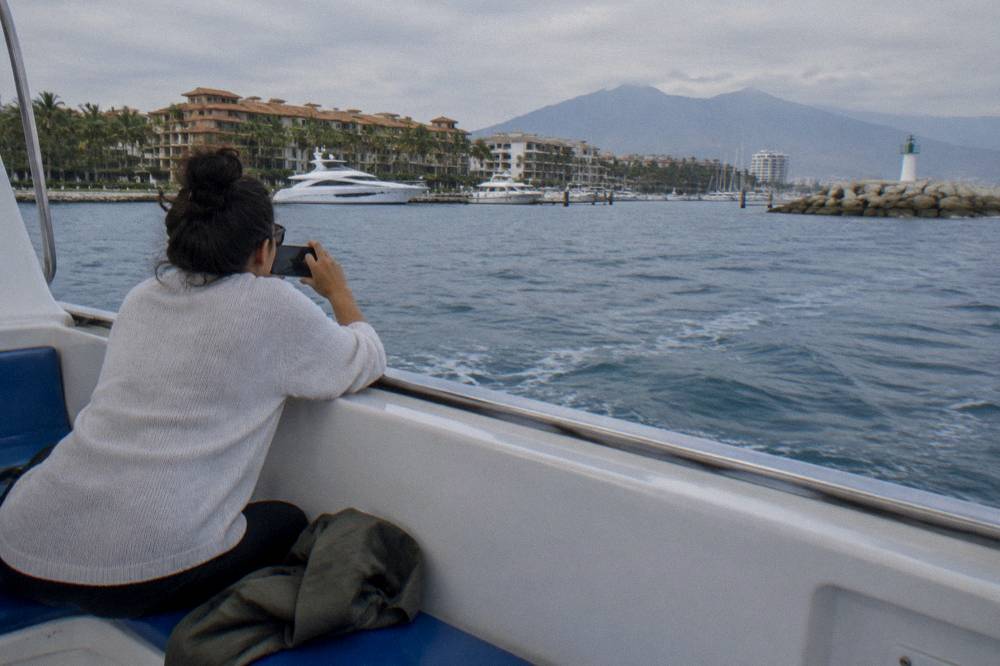
On a dry-storage note: sea spray and phone rails do not mix. A lanyard case costs almost nothing and has saved more devices on Banderas Bay boats than any waterproof rating; check the packing advice in what to bring on a whale tour for the full list.
Which Puerto Vallarta Boats Give Photographers The Best Vantage?
Small-group boats with open rails, flexible movement and a hydrophone are the photographer's choice: the photo safari from $79 per person, the Ecotours Vallarta biologist-led trip from $120 and the whale encounter from $99 per person all qualify. Private charters such as the 5.0-rated Vallarta Natours tour from $760 per group give the ultimate advantage, an entire rail to yourself.
Deck layout decides your images more than any spec sheet. On a shared cruiser carrying dozens, you shoot from one assigned spot and take what the whale gives your side of the boat. On a small-group vessel you follow the animal along the rail, and the crew on the small-group half day with lunch, rated a perfect 5.0 from 353 reviews, actively rotate guests between sighting runs. From Sayulita, the biologist-led 3 hour trip direct from the beach, from $90 per person, runs small boats where everyone is within two steps of a rail.
Timing within the trip matters too. Trips that hold a whale with a hydrophone, engines idling as the rules require, give you stable water for close focus work, and the biologist narration tells you what behavior is coming next. A whale that raises its fluke high and slow is about to dive for minutes; that is your cue to lower the camera, rest your arms and watch for the next surfacing.
| Boat style on the roster | Photography advantage | Trade-off |
|---|---|---|
| Small-group photo safari (from $79 pp) | Named for photography, hydrophone, pickup listed | Snack only, no meal |
| Biologist-led small group, Ecotours (from $120 pp) | Lecture plus hydrophone, 3.5 hours on the water | Highest per-person shared price |
| Whale encounter, Eco Explorer (from $99 pp) | Snacks, hydrophone, 530 reviews of feedback | Fixed itinerary pace |
| Private charter, Vallarta Natours (from $760 per group, up to 8) | Whole rail, guide attention, lunch included | Price per group, needs a party |
| Catamaran with breakfast and buffet (from $99 pp) | Stable platform, food and open bar | Crowded rails, slower maneuvers |
The private versus shared whale tours guide breaks down the cost math if a charter tempts you after seeing the table above.
What Rules Affect Photographers On Whale Tours In Mexico?
Federal rule NOM-131-SEMARNAT-2010 caps approach at 60 m for small boats and 80 m for larger ones, allows at most 4 boats around one whale, limits each encounter to 30 minutes, and bans jet skis, kayaks, canoes and swimming near whales. Authorised boats fly a numbered federal flag. None of this stops photography; it just sets your working distance.
Know the numbers because they set your expectations honestly. At 60 m, a 300mm lens on a full-frame body renders an adult humpback across a useful portion of the frame width, which is a good image, not a frame-filler. The 30-minute per-whale cap is generous for photography; the boat will reposition to other animals rather than hovering on one. At most 4 vessels may cluster, so if you can see three boats already around a whale, your captain will wait at 240 m, and that waiting period is exactly when to shoot wide habitat frames.
The regulation also protects what you are photographing. The Mexico humpback population, which breeds along the Pacific coast and feeds from California to the Aleutians, is listed as Threatened by NOAA, and the two restricted zones in the bay, a 1.5 km radius around the Islas Marietas and a 2 km coastal strip from Punta Mita to the Rio Ameca, exist because mother-and-calf pairs concentrate there. The full approach rules are detailed in our guide to whale watching rules and distance in Mexico. If you're weighing whether Banderas Bay or Los Cabos makes the better base for your trip, our guide to choosing Cabo or Puerto Vallarta for whale watching compares what each destination can genuinely deliver.
Drones deserve a plain warning: no federal drone rule for whale watching was found on the record, but the norm bans ultralights and helicopters for observation, and harbor authorities and tour operators generally prohibit drone launches from whale boats. Ask before you fly, and expect the answer to be no. The official season notice is published in the Diario Oficial de la Federación, and enforcement reporting appears on the PROFEPA press page.
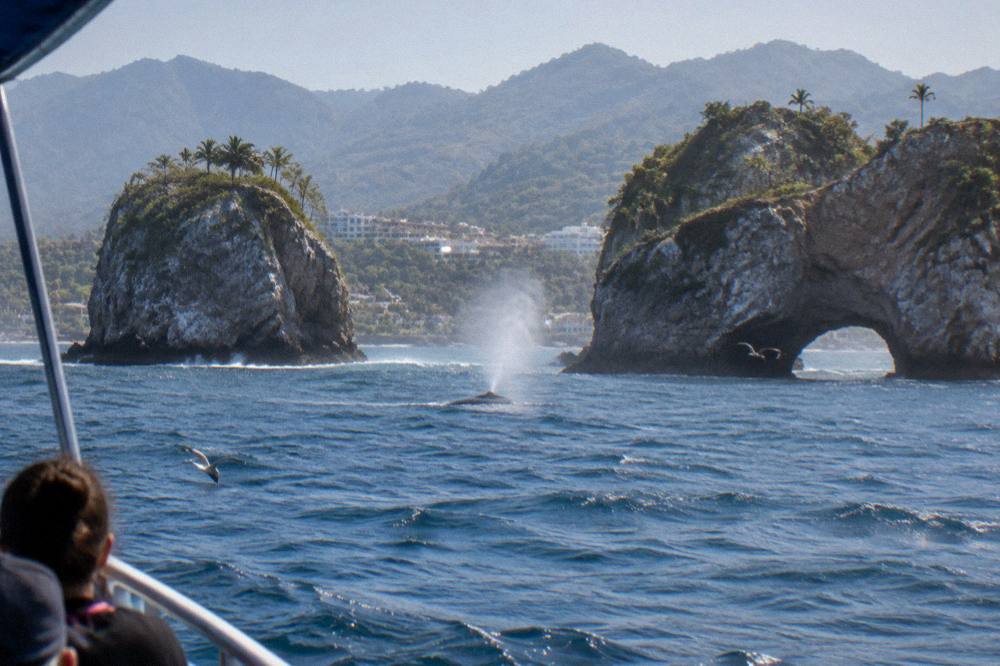
Behavior reading, covered fully in our guide to humpback whale behavior in Banderas Bay, is the last skill that separates keepers from missed frames. A whale that accelerates at the surface with a rising tail stock is about to breach; one that logs flat is giving you calm portraits. Spend the first fifteen minutes of any trip learning the local pattern before you commit your settings. Species facts and biology, up to that 40-ton adult weight, are documented by NOAA Fisheries.
Whatever boat you book, do it with an operator that works inside these rules; Puerto Vallarta Whale Watching exists to make that comparison easy, and every listing covered here runs under the federal flag system.
Common Questions About Whale Watching Photography
What shutter speed do I need for whale photos?
1/1000s as your baseline, and faster still for breaches and fluke slaps. From a moving boat the deck adds motion to the whale's own, so err fast and raise ISO rather than dropping shutter. Only slow down to 1/500s for a resting, stationary whale.
Is a 200mm lens enough for humpbacks in Banderas Bay?
It is workable but limiting. Boats hold 60 to 80 m from whales under federal rules, so a 200mm yields habitat-heavy frames with small subjects. A telephoto zoom reaching 300mm is the most versatile single lens for the bay; phones and wide lenses only shine on close passes.
What time of day is best for whale photography in Puerto Vallarta?
The 8 a.m. to 10:30 a.m. window, when directional light models the whale's body and the sea is usually calmest. Late afternoon brings golden color but more chop. Book the earliest departure your chosen boat offers.
Can I use a drone to photograph whales in Banderas Bay?
Treat drones as off-limits. The federal norm bans aircraft including ultralights and helicopters for whale observation, and operators and harbor authorities generally prohibit launching from tour boats. Ask before flying, and expect a no.
Which whale tour is best for photographers?
Small-group boats with open rails and hydrophones: the photo safari from $79 per person, the Ecotours Vallarta biologist-led trip from $120 per person, or a private charter such as the Vallarta Natours tour from $760 per group for a whole rail to yourself.
Do I need a polarizing filter for whale photos?
It helps cut surface glare on sunny mornings, but it costs light, which forces higher ISO at your fast shutter speeds. Many photographers skip it and instead underexpose slightly and angle shots away from the glare cone.