How To Tell If A Whale Is Near: Blows, Tails And Splashes
The visual and audio cues boat crews use to find humpbacks in Banderas Bay, from the first blow on the horizon to fluke-up dives, splashes and hydrophone song.
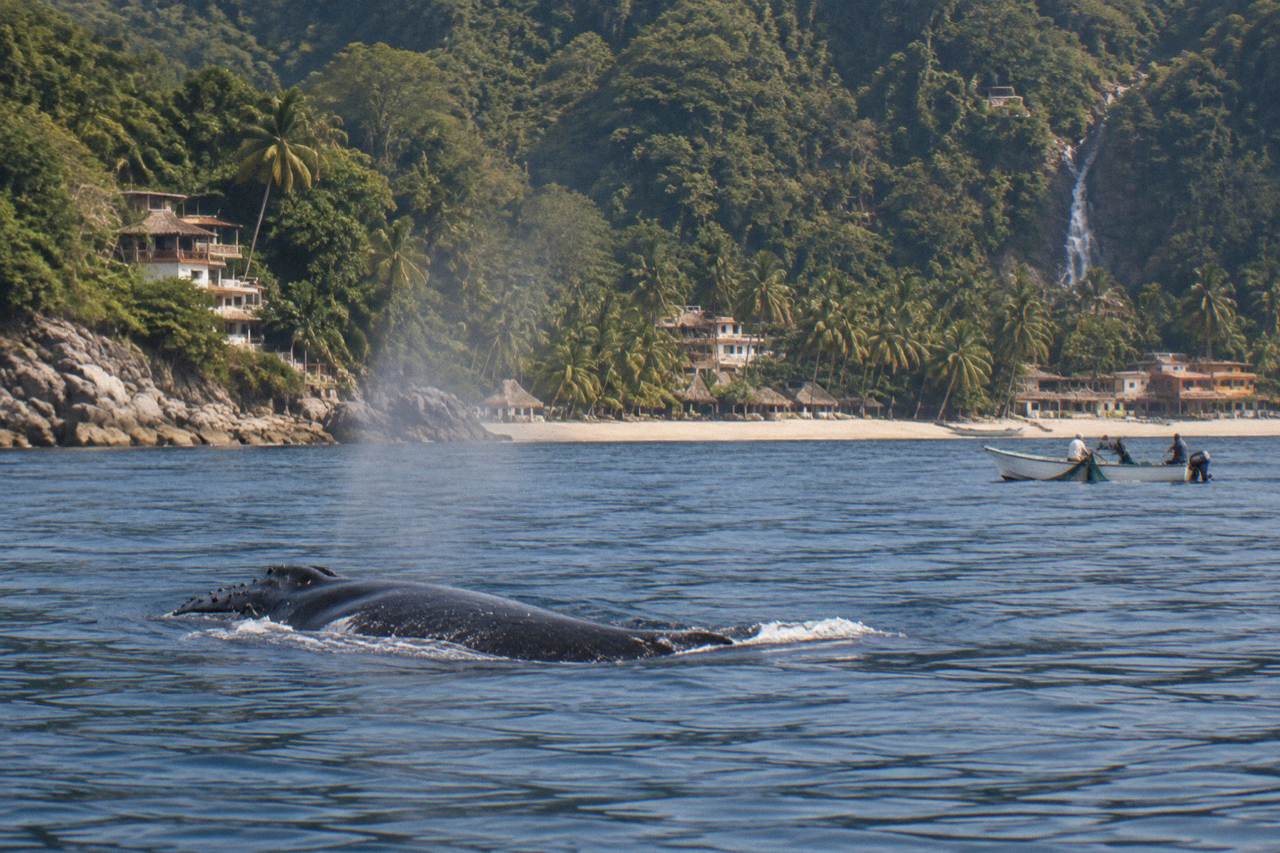
Humpbacks do not announce themselves with a horn. What they do instead is leave a trail of small, readable signs on the surface of Banderas Bay: a column of mist, a black shape rolling through swell, a tail lifting against the light, a white explosion where a 40 ton animal has thrown itself out of the water. The difference between a passenger who sees two whales and one who sees eight is usually not where the boat went. It is knowing what to watch for, and how early. Boat crews scan the bay continuously, and the cues they respond to first are the same ones any passenger can learn in a morning.
A good guide helps enormously here. The biologist-led boats explain each cue as it happens, and some carry hydrophones that let you hear a whale long before it surfaces. The Whale and Dolphin Watching with Hydrophone tour, from $62 per person and rated 4.5 from 24 reviews, is built exactly around that pairing of eyes and ears.
How To Tell If A Whale Is Near: Blows, Tails And Splashes
You tell a whale is near by scanning the horizon for a vertical plume of mist, watching for dark backs rolling at the surface, and catching any unexplained white splash or disturbance against the swell. A single tall, lingering blow is the cue crews respond to fastest, because it is visible from far away and repeats every few minutes as the whale breathes.
The bay gives you an advantage over most whale watching destinations: open water, a long horizon and, in season, a resident population of roughly 500 individual humpbacks, a figure reported by the local research group ECOBAC. With that many animals spread across 987 square kilometers of water, the question is rarely whether whales are out there. It is how to pick them out of the glare and the chop.
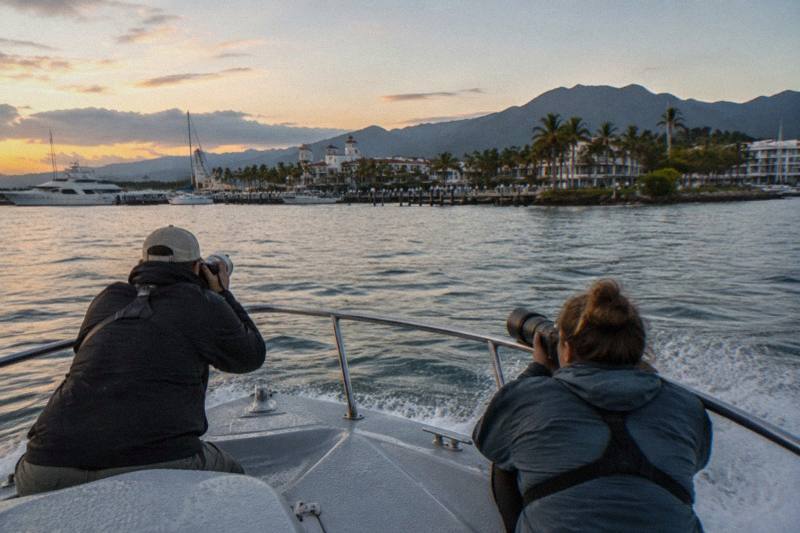
Scan in a systematic sweep rather than staring at one patch of ocean. Crews divide the horizon into sectors and work across them, low, checking anything that breaks the rhythm of the waves. The rhythm is the key. Swell moves in lines. Birds sit as dots. A whale breaks the pattern, and once you have seen one break, your eye starts finding them on its own.
If you want a deeper background on what the animals are actually doing when you see these cues, our guide to humpback behavior in Banderas Bay covers breaching, spy hopping and tail slapping in detail.
The Blow: The First Sign On The Horizon
A blow is the exhale of a surfacing whale, a tall, faint column of vapor that hangs for a moment above the water. It is the single most useful cue on the bay because it is visible at distances where the animal itself is not, and it repeats, so a spotter can mark the spot and wait.
The humpback's blow is bushy and relatively short compared with the tall narrow column of some other species, but from a rolling deck it reads the same way: a smudge of white or gray rising off the surface, holding a beat, then gone. Against a dark headland it shows pale. Against bright sky it shows darker than the background, so the trick is contrast, not color. The National Oceanic and Atmospheric Administration's species profile describes humpbacks reaching about 60 feet and about 40 tons; an animal that size moves a lot of air when it breathes, and that air condenses into the plume you see.
Do not chase the first spout you spot. Whales typically take several breaths in a sequence, diving and resurfacing a short distance on, so the crew's move is to hold course, watch where the animal is traveling, and let it come into comfortable range rather than motoring straight at the last known position. Patience is also written into Mexican law: federal rules require boats to hold back at a distance and approach slowly, more on that below.
A second, smaller blow beside a bigger one is the classic signature of a mother and calf pair. Mothers with calves are a central reason the season is regulated the way it is. The restricted zones in Banderas Bay, a 1.5 kilometer radius around the Islas Marietas and a 2 kilometer coastal strip from Punta Mita to the Rio Ameca mouth, were drawn specifically around mother and calf concentrations, per the SEMARNAT notice published in the official gazette on 10 October 2025, which also set the official 2025 to 26 season window of 8 December to 23 March.
Here is how the main surface cues stack up against each other as spotting tools:
| Cue | What it looks like | What it means | How reliable for spotting |
|---|---|---|---|
| Blow | A faint vertical column of mist, pale against dark water | The whale is at the surface and breathing | The best long-range cue, it repeats with each breath |
| Back and dorsal fin | A dark shape rolling through the swell | The whale is traveling just under the surface | Good at medium range, easy to lose in chop |
| Fluke-up dive | Tail flukes rising vertical, water sheeting off | The whale is leaving on a deeper dive | A stop cue, the spot goes quiet |
| Tail or fin slaps | Rhythmic heavy white splashes in one spot | Surface activity, generally read as communication | Very reliable, the splash repeats and carries |
| Breach | The whole animal clears the water, then a huge splash | Often part of a sequence rather than a single event | Loud and visible, but usually over before you arrive |
| Hydrophone song | Nothing visible, singing heard under water | A whale is stationary somewhere below | An audio cue only, needs a boat with a microphone |
When a blow is finally located, the naturalist's job begins. On the biologist-led options such as the Whale Watching Adventure Led by a Marine Biologist, from $120 per person and rated 5.0 from 168 reviews, the guide narrates each surfacing, calling the breath count so everyone on board knows whether to expect the whale up again in seconds or down for a longer dive.
Fluke-Up Dives And What A Raised Tail Tells You
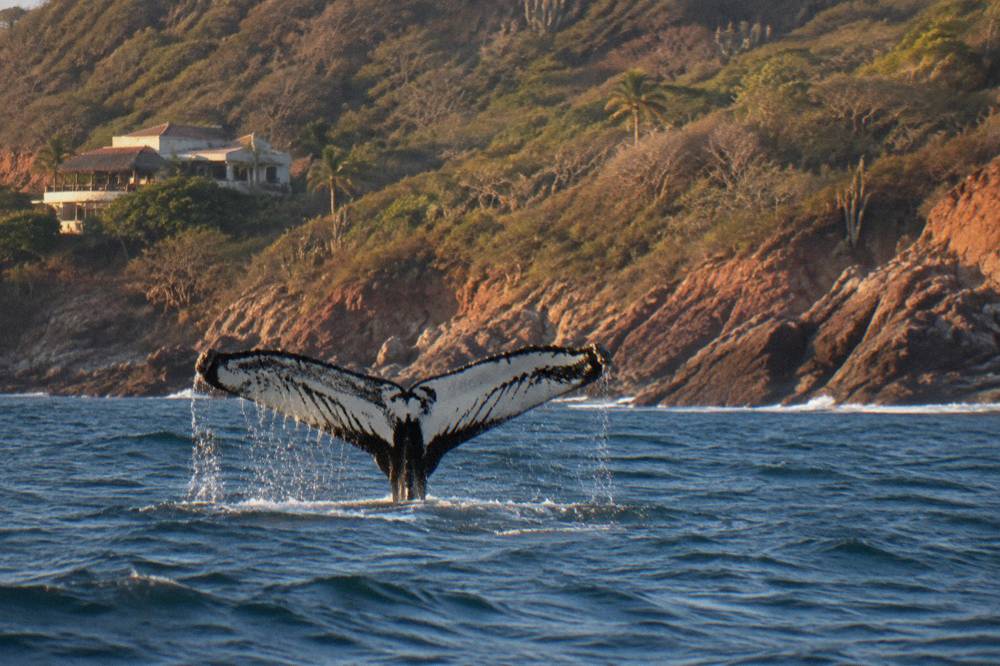
A fluke-up dive, where the whale lifts its tail flukes clear of the water before sliding under, is the clearest signal that the animal is leaving the surface for a deeper dive. Crews read it as a stop cue: nothing more is about to happen at that spot, and the search resets.
The raised tail is the most photographed moment in whale watching for good reason. It is unambiguous, it is slow enough to catch with any camera, and it ends the show. When the flukes come up vertical and water sheets off them, the whale has tipped head-down and is going deep. The surface where it happened is now just water.
For a passenger, knowing this changes how you spend the downtime. Instead of staring at an empty patch of sea waiting for the animal to reappear, you can go back to scanning the horizon for the next blow elsewhere. The whale will surface again, but likely well away from where it dove, and the crew will already be looking for it. The pattern of cue, sighting, fluke-up, reset, is the rhythm of every whale trip on the bay.
Tail slaps are different, and louder in meaning. A whale repeatedly slapping its flukes on the surface is producing sound that travels, and the behavior is generally read as communication rather than travel. It is one of the surface behaviors the NOAA species page and field guides list among humpback social activity, and it is visible, and audible, from a long way off. A patch of water exploding in rhythmic white splashes, with no boat anywhere near it, is worth pointing out to the crew immediately.
The small-group photo safari format is designed around exactly these moments. The Whale Photo Safari run by Vallarta Adventures, from $79 per person and rated 4.7 from 190 reviews, carries hydrophones and a light snack on a smaller boat, which suits photographers who need space to swing a lens when the flukes go up.
Splashes And Breaches: The Cue You Can Hear
A breach is the whole animal clearing the water, and the splash it makes landing is audible across a surprising distance. Any large, sharp, white splash that does not match the swell pattern is a cue to watch, because humpbacks often breach in sequences rather than once.
The sound arrives before the certainty. On a calm morning a 40 ton body hitting the sea makes a report like distant surf or a door slamming, and heads turn toward it before anyone has seen anything. The white watermark it leaves, a expanding patch of foam sitting still while everything around it moves, is what confirms it.
The habit that matters for a spotter is repetition. Humpbacks that breach once commonly breach again within a short window, sometimes in a run of several. Crews treat a distant breach as an invitation to slow down and watch the neighborhood, not necessarily to charge over, since by the time a boat covers the gap the sequence may be finished. Federal rules cap any boat at 30 minutes with the same whale or group and limit how fast a vessel may travel inside observation areas, so a distant splash is often best enjoyed from where you are.
Other splashes to read: a pectoral fin slapping sideways, a slap of the tail, and a head lift called spy hopping all leave different signatures. The pectoral slaps of a humpback, with its long white flippers, are distinctive because the white of the fin flashes before the splash. Distinguishing these gives you a vocabulary to share with the crew, and crews respond well to a passenger who can say "fin slapping at two o'clock" rather than "something splashed over there."
A note on what splashes are not. Dolphins move in fast, low arcs with small punctuating splashes; a whale's surface activity is heavy, slow and vertical by comparison. Fishing activity near the surface, jumping rays and bird dives can all imitate a cue at the edge of vision. The test is always the same: does it repeat, and does it break the swell's rhythm.
Listening: The Hydrophone Advantage
A hydrophone turns whale watching from a purely visual search into an audio one. Singing humpbacks can be detected under water while nothing at all is visible above it, which lets a crew idle in the right neighborhood rather than guess, and gives passengers the eerie experience of hearing a whale that has not shown itself yet.
Several boats on the bay carry underwater microphones, and the listings state it plainly. The Whale and Dolphin Watching with Hydrophone tour from $62 per person lists a hydrophone and a marine biologist among its inclusions, along with drinks and a morning lunch. The Whale Encounter tour run by Eco Explorer Vallarta, from $99 per person and rated 4.9 from 530 reviews, also lists a hydrophone. The featured whale and dolphin trip from $105 per person, rated 4.9 from 702 reviews, is led by a biologist and includes bottled water, soda, a baguette sandwich for lunch and granola-bar snacks.
Under Mexican rules the engine is supposed to be in idle or neutral when a whale is stationary near the boat, and the norm even allows engines to be shut off specifically so a hydrophone can be used. That is why the quietest moment of a trip, engines down, microphone dropped, is often the moment passengers describe as the best one: a humpback song coming up through the hull, with the singer somewhere below and unseen.
The audio cues complement the visual ones rather than replacing them. A singing whale is usually stationary below, so the crew that hears one knows roughly where to wait. A blowing whale is by definition at the surface, so the crew that sees one knows where to look. The best trips use both, and if hearing the song matters to you, pick a listing that names a hydrophone in its inclusions rather than assuming every boat carries one.
Distance Rules And Why They Change The Way You Spot
Mexican regulation NOM-131-SEMARNAT-2010 sets how close boats may go: 60 meters for small boats, 80 meters for medium and larger ones, with a 240 meter waiting distance and a maximum of four boats around any one whale or group. These distances are also, in effect, your spotting ranges, because the whales are usually first detected well outside them.
This is the part most first-timers misunderstand. A boat cannot and should not pull up beside a whale. What happens instead is a patient, staged approach at low speed, below 5 knots inside observation areas and below 2 knots on entering, with the engines idling when the animal is still. So the first minutes of any encounter are long-range minutes, and that is precisely when your blow-spotting and splash-reading skills pay off. The passengers who spot the whale while it is still a smudge on the horizon get extra minutes of watching that the passengers still looking at their phones never get.
Authorized boats fly a numbered flag with the federal seal, and unlicensed vessels must stay 240 meters away from any whale. Enforcement is real: the federal environmental prosecutor's office runs inspections through the season, and one operation on the Nayarit side of the bay boarded 17 vessels to check permits and compliance. Choosing a licensed operator is not paperwork, it is the mechanism that keeps the whales, and your encounter, working.
The full rulebook, including what is prohibited in whale zones, is laid out in our guide to whale watching rules and approach distances in Mexico.
Practice Drills You Can Run On Any Tour
Three habits turn a passive passenger into a useful spotter: sweep the horizon in sectors rather than staring, check every splash against the swell's rhythm before dismissing it, and call bearings in clock terms so the crew can act on what you saw. Each takes one trip to learn.
The clock-face habit deserves a minute of explanation. Boats have a bow, and the bow is twelve o'clock. A blow off the right beam is three o'clock, dead astern is six. Saying "blow at ten o'clock, mid distance, mother and calf" gives a captain everything needed in five words, and crews on the small-group boats, like the Small-Group Half-Day Whale-Watching Tour with lunch and a marine biologist guide, from $110 per person and rated 5.0 from 353 reviews, genuinely act on passenger calls.
Timing also shapes the odds. Sightings happen all day, but surface activity patterns differ between early morning and midday, a question covered in detail in our piece on the best time of day to see whales. The broader planning questions, which month, which departure port, which boat type, are handled by the trip picker on the Puerto Vallarta Whale Watching homepage and the season guide, leaving you free to spend this page's skills on the water.
One last practice point: keep your eyes mostly on the horizon, not the water next to the boat. The whale you can see without binoculars beside the hull will announce itself. The whale the whole boat gets to watch for ten minutes is the one somebody found first, far out, as a pale column hanging over the water.
If learning the cues has you planning a trip around them, the season window matters more than the boat: the official record ran 8 December to 23 March last season, operators advertise the same 8 December opening this year, and the federal notice for the new season has not appeared yet, so book with free cancellation where the listing offers it and stay flexible on dates. On timing within the day, and on which of the three tour styles below suits your eyes and your ears, the comparisons on this site go deeper than one article can.
Common Questions About Telling If A Whale Is Near
How to tell if a whale is near?
Look for a tall column of mist on the horizon, a dark back rolling through the swell, or a large white splash that breaks the rhythm of the waves, and watch for repeated cues since whales surface in sequences. A raised tail means the whale is diving deep, and a rhythmic series of heavy splashes usually means surface activity worth pointing out to the crew.
How far away can you see a whale blow?
There is no verified figure for how far a blow is visible in Banderas Bay, and honest guides decline to give one, because visibility changes with light, glare and sea state. What is documented is the regulated approach: crews first spot blows well outside the 240 meter waiting distance and the 60 to 80 meter approach limits set by Mexican rule NOM-131.
What does it mean when a whale lifts its tail out of the water?
A tail raised vertically before the whale slides under, called a fluke-up dive, signals a deeper dive rather than more surface time. The crew stops watching that spot and resumes scanning the wider bay, because the whale will surface again somewhere else.
Can you hear whales before you see them?
Yes, if the boat carries a hydrophone. Several listings on the bay name an underwater microphone among their inclusions, and Mexican rules allow engines to be shut off so it can be used. Singing humpbacks can be heard under water while nothing is visible above it.
Why does the boat stay so far from the whale?
Federal rule NOM-131-SEMARNAT-2010 sets approach distances of 60 meters for small boats and 80 meters for larger ones, a 240 meter waiting distance, a four-boat limit around any whale, and a 30 minute time limit, to keep the animals from being harassed. The distance also means the first minutes of an encounter are long-range, which is exactly when spotting skills matter.