Is Puerto Vallarta Safe To Visit Right Now?
A practical safety answer for Puerto Vallarta visitors: federal whale-watching rules, authorized boats, life vest requirements, hurricane season dates, and why your own government's advisory is the source to check.
Every year, travelers ask some version of the same question before booking a winter trip: is it still safe to travel to Puerto Vallarta right now? This site covers whale watching on Banderas Bay, so this article answers the safety question the only honest way available, from the verified record rather than from rumor. No crime statistic, advisory level or incident figure appears here, because none is verified in our research files. What is verified is the federal rulebook that governs every licensed whale boat on the bay, the season it applies to, and the weather calendar that shapes every departure. Readers planning a trip can start with the Puerto Vallarta Whale Watching homepage comparison or the trip picker, then use the on-water facts below to judge operators for themselves. Once you feel confident about safety, the honest odds of spotting a whale on a Banderas Bay tour explain what the season dates and tour rules mean for your actual chances.
The question usually arrives tangled with several smaller ones. Is the bay itself safe to be on in a small boat? Are the tour operators regulated, or is anyone with a skiff allowed to sell whale trips? Does the weather turn dangerous at certain times of year? Those are answerable, and the answers below draw only on primary federal sources and the verified roster of tours this site compares. The one question this article will not pretend to answer is the security statistics question, and the reasons for that are explained plainly in the first section, because knowing what a source cannot tell you is as useful as knowing what it can.
Is Puerto Vallarta Safe To Visit Right Now?
No verified advisory level or incident statistic exists in this site's research files, so the only trustworthy source for the security question is your own government's current travel advisory, checked close to your travel date. What can be answered here with primary sources is everything that happens on the water: Mexico regulates whale watching on Banderas Bay under a binding federal norm, the season runs roughly December to March, and authorized boats are inspected through the season. If you're bringing children along, the family whale watching guide covers the age rules and life jacket requirements on the bay.
The security half of the question is genuinely outside this site's lane. We compare whale tour listings; we do not audit cities. Any page that prints a confident "totally safe" or "avoid" verdict without citing an official advisory is doing marketing, not reporting. Check your government's current travel advisory before you book flights, and check it again the week you fly, because advisories change. A travel forum post from last winter, a resort's reassurance page, or a headline you half remember are not substitutes for the advisory itself, which is refreshed on a regular cycle and is the single document your travel insurance may also reference.
The on-water half is different. That half is documented in the Diario Oficial de la Federación, in the national norm NOM-131-SEMARNAT-2010, and in enforcement reporting from the federal environmental prosecutor. When you board a licensed whale boat in Puerto Vallarta, you are stepping into one of the more tightly regulated tourist activities in Mexico. The rules cover how close the boat may come, how fast it may move, how long it may stay, and what it may never do. Few casual beach activities anywhere carry a comparable written rulebook with inspection operations attached. If you're wondering whether all that oversight translates into an experience worth paying for, our whale watching worth-it verdict walks through real prices and the letdowns travelers mention most.
That regulation is the reason whale watching here is a reasonable activity for cautious travelers. A shared boat like the biologist-led whale and dolphin tour that departs Opequimar Marine Center, the small-group half day with lunch from Marina Vallarta, or a private charter all operate inside the same federal rulebook, whatever their price point. The cheapest option and the most expensive yacht on this site's roster obey identical approach distances and speed limits, so choosing a budget listing does not mean choosing a looser safety standard.
What Rules Keep A Whale Boat Safe On The Water?
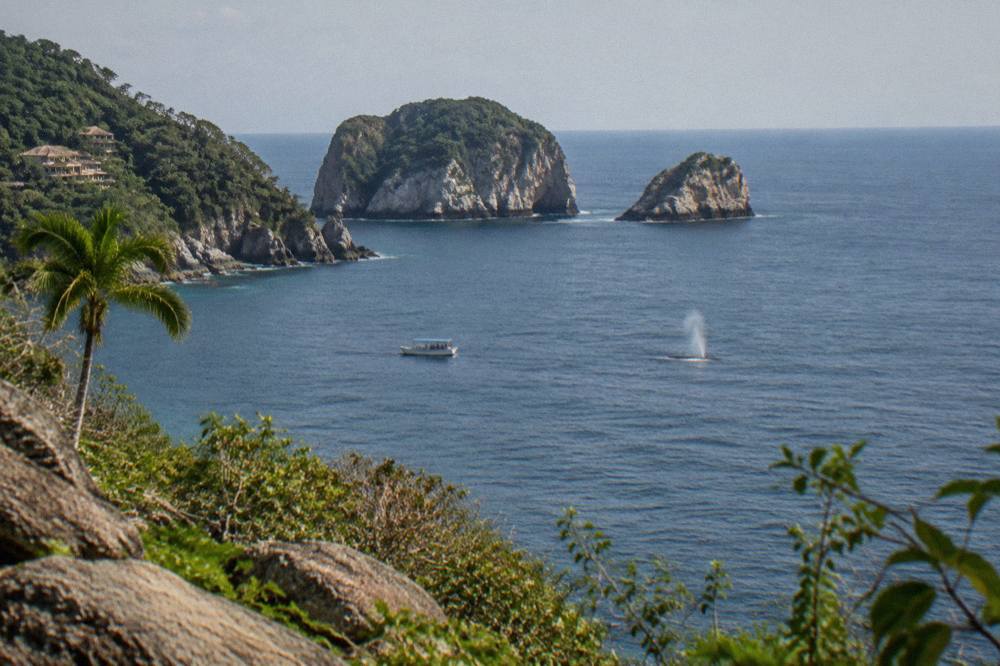
NOM-131-SEMARNAT-2010 sets hard numbers: boats wait at 240 meters, approach no closer than 60 meters for small craft or 80 meters for larger ones, spend at most 30 minutes with the same whale, keep at most four boats around it, and travel below 5 knots inside observation areas. Swimming with whales is prohibited outright, and no licensed boat may put you between a mother and calf.
The norm was published in the Diario Oficial in October 2011 and remains the binding standard. Its numbers are worth knowing as a passenger, because they let you recognize good behavior when you see it. A compliant boat slows dramatically well before it reaches a whale, drifts or idles rather than charging, and leaves an encounter before crowding develops. If a vessel is racing a whale, cutting in front of its path, or letting five or six boats stack up around one animal, it is breaking federal law, and you are watching it happen.
Enforcement is real rather than theoretical. PROFEPA, the federal environmental prosecutor, runs inspection operations in the bay through the season; one Nayarit-side operation boarded and verified 17 vessels, tourist and private alike, checking permits and compliance. Authorized boats fly a numbered flag carrying the federal seal, which is the fastest visual check a passenger can make from the dock. The presence of inspectors also changes operator behavior in advance, since a permit problem found mid-season can end a season, and the larger operators know it.
The rules also forbid jet skis, kayaks, canoes and any swimming, diving or fishing in whale observation zones. That is why the snorkel combos on this site's roster, such as the whale and snorkel combination from Los Peines marina, do their snorkeling at a separate reef or beach stop and never in the water with humpbacks. Any product implying you can swim with the whales is either confused or dishonest. There is one further nuance worth knowing: the norm allows an engine to be shut off or set to idle specifically so a hydrophone can be used, which is why the hydrophone listings on this roster, including the marine-biologist-led adventure from Ecotours Vallarta, describe listening to whale song rather than chasing whale song.
| Rule under NOM-131-SEMARNAT-2010 | The number | What it means on board |
|---|---|---|
| Waiting distance | 240 meters | Boats hold back far from the whale before any approach begins |
| Approach distance, small boats | 60 meters | Closer than this is a violation, no exceptions |
| Approach distance, medium and large boats | 80 meters | Bigger hulls stand off farther |
| Boats around one whale or group | At most 4 | Crowding is illegal, not just rude |
| Time with the same whale or group | At most 30 minutes | The captain must move on |
| Speed in observation areas | Below 5 knots (9 km/h), and below 2 knots (4 km/h) on entry | The boat slows long before you reach the whale |
| Activities prohibited | Swimming, diving, fishing, water skiing, jet skis, kayaks | No in-water contact with whales, period |
| Mother and calf | Never position between them | The most serious rule in the norm |
The season itself is set by federal notice. Last season's SEMARNAT aviso, published in the Diario Oficial on 10 October 2025, ran the official window from 8 December 2025 to 23 March 2026, and closed whale watching outside it. Operators advertise the same 8 December opening for the season ahead, but the federal notice for that season has not appeared yet, so treat any December trip as contingent on the official publication. More season detail sits in our Banderas Bay season dates guide.
The aviso does one more thing that matters to a safety question: it draws two restricted zones where whale watching is prohibited entirely, a 1.5 kilometer radius around the Islas Marietas and a 2 kilometer wide coastal strip running from Punta Mita to the Rio Ameca mouth. Those closures exist because mother-and-calf pairs concentrate there, and the regulators' reasoning is worth internalizing. The whole framework treats the whales' condition and the passengers' safety as one system, since a stressed animal near a boat full of people is the scenario every rule is written to prevent.
Is Hurricane Season A Reason To Avoid The Bay?
Hurricane season in the Eastern Pacific runs 15 May to 30 November, which overlaps the start of the whale-watching window, so late-fall storms are the main weather factor in a December or March trip. Rainfall data shows July through September carry 20 to 21 rain days per month, while the whale months of January through April sit at one to two rain days.
The verified climate record makes the pattern plain. June through September bring the heavy months: 227 to 429 millimeters of rain and roughly three weeks of rain days each. By January the figures fall to 37 millimeters across two days, February to 12 millimeters across one. The whale-watching season is deliberately placed in the dry half of the year, and the air temperatures in January through April, means of 21.8 to 23.3 degrees Celsius, are the mildest of the calendar. Sea temperatures in the same months sit between 23.9 and 24.9 degrees Celsius, so the water itself is not a shock factor on a trip that includes swimming or a beach stop.
| Month | Rain days | Rain (mm) | Why it matters for a bay trip |
|---|---|---|---|
| January | 2 | 37 | Peak whale season, dry |
| February | 1 | 12 | Operators and guides name January and February as peak months |
| March | 1 | 4 | Late season, dry, season closes late March |
| July | 20 | 362 | No whale season; wettest stretch begins |
| September | 20 | 429 | Hurricane season still open, heaviest rain |
| November | 2 | 24 | Storms possible until 30 November; season opens early December |
Storms are the reason booking flexibility matters. Every listing on this site's roster that states a cancellation policy lists free cancellation, and a weather-driven cancellation is exactly the scenario that policy exists for. Operators will not run a small boat into heavy weather, and the port authority can close navigation to smaller vessels when conditions demand it. Treat a free-cancellation listing as part of your safety planning, not just a convenience. NOAA tracks the Eastern Pacific hurricane season formally, and its humpback whale species page is also the primary source for the Mexico population this site cites, which NOAA lists as Threatened under the Endangered Species Act.
If a storm system does disrupt your dates, the practical sequence is usually simple: the operator cancels, the cancellation policy refunds or rebooks, and the same trip runs the next calm morning. Mid-season, in January or February, storm influence on the bay is rare enough that most visitors never think about it, which is the quiet argument for traveling in the peak rather than the opening week of December.
Worried a trip might not suit the weather? The small-group Whale Encounter run by Eco Explorer Vallarta lists free cancellation, so a storm-shifted plan does not have to mean a lost booking.
How Do You Spot An Authorized Whale Boat?
Authorized vessels fly a numbered flag bearing the federal seal, hold SEMARNAT permits, and are the only boats legally allowed near whales at observation distances; unlicensed boats must stay 240 meters away. If a dockside operator cannot point to the flag or the permit, that is your answer, walk to the next pier.
The flag check takes ten seconds. Before boarding anywhere, whether at Marina Vallarta, the Puerto Magico terminal, Opequimar Marine Center or the Los Peines pier, look for the numbered banderola on the vessel. Operators must hold valid SEMARNAT authorization for non-extractive wildlife use, and enforcement operations verify exactly that paperwork. Unlicensed boats are not merely discouraged from approaching whales; the norm requires them to hold at 240 meters, which in practice means they cannot offer a whale tour at all.
Reputable operators make this easy. The roster's established names state their compliance in plain terms: Eco Explorer Vallarta's Whale Encounter listing includes government permits and conservation wristbands among its inclusions, Ecotours Vallarta's marine-biologist-led trip includes a hydrophone used under the norm's engine-idle provisions, and Mike's Fishing & Tours runs the catamaran cruise with a biologist on board. A listing that mentions permits, a biologist or a hydrophone is describing the regulated product; a beach vendor offering a cheap speedboat ride with no paperwork is describing something else. The price difference between the two is not the interesting part. The interesting part is what happens if something goes wrong, because a permitted operator has a company, an insurance expectation and a reputation to answer with.
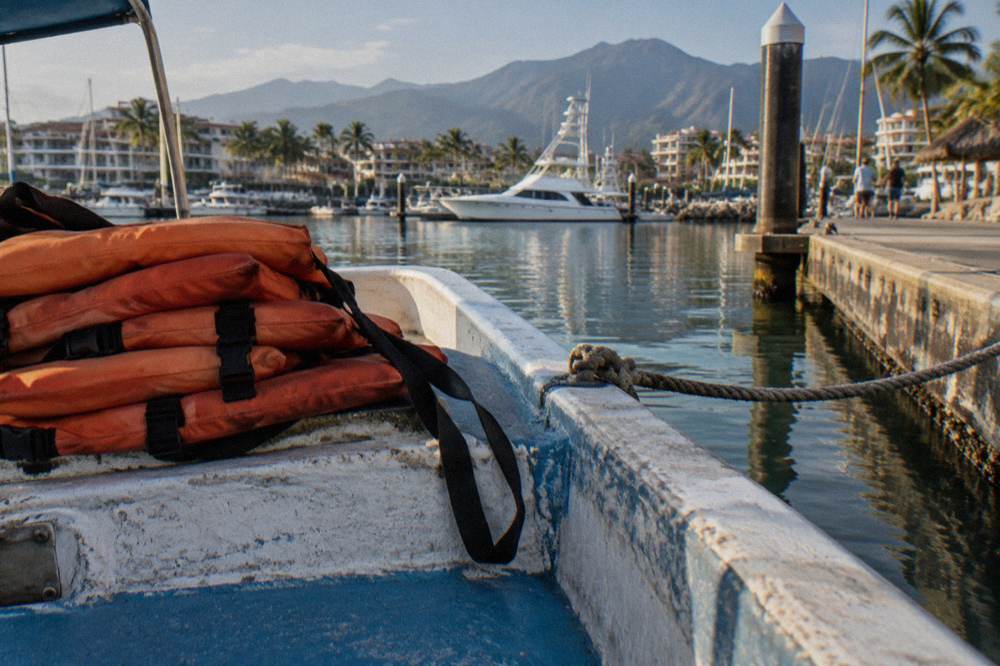
Life vests are the other quick check. Most roster listings include them explicitly, from the Whale Encounter's vests to the Vallarta Whales trip's safety equipment to the 3-hour whale and snorkel combo's included life jackets. If vests are not visible and not stated on the listing, ask. Our rules and distance guide walks through the full norm if you want the detail.
What Should You Check Before Booking Any Bay Tour?
Five checks cover most of the risk: the numbered federal flag, the listed free-cancellation policy, the stated departure point, the life vest inclusion, and the operator's stated guide credentials. All four are visible on the listing before you pay anything, and every roster tour on this site publishes at least the first three.
Departure point matters more than visitors expect, because it determines the water you cross and the transfer you take. Verified departure points on this roster include Marina Vallarta, the Puerto Magico terminal, Opequimar Marine Center, the Nuevo Vallarta marina, the Los Peines pier, La Cruz marina and Sayulita beach. Operator transfer sites put the airport at 15 to 22 minutes from Marina Vallarta, which is useful when you are judging a same-day arrival departure. Our marina comparison guide breaks down the trade-offs.
Age and health rules are not on file for these listings, so check each listing for the operator's own age and health requirements rather than assuming. The same goes for pickup: only some listings state hotel pickup, and a listing that does not state it likely does not include it. This is a general principle worth applying to every claim on a booking page: print what is stated, ask about what is not, and treat "not stated" as a question rather than an answer.
One more framing helps. About 500 individual humpbacks visit the bay per season according to ECOBAC, the local research group, and the federal restricted zones, a 1.5 kilometer radius around the Islas Marietas and a 2 kilometer coastal strip from Punta Mita to the Rio Ameca mouth, exist precisely to protect mother-and-calf pairs. The system is built around the whales' safety and yours together, which is why the behavior guide and the rules are worth reading before a first trip. A bay with a written approach distance, a seasonal closure and an inspectorate is a bay that takes the question you asked, is it safe, seriously enough to have answered much of it in advance.
Common Questions About Puerto Vallarta Safety
Is it safe to travel to Puerto Vallarta right now?
This site publishes no advisory level or crime figure because none is verified in its research files. Check your own government's current travel advisory close to your travel date. The on-water side of your trip is regulated under NOM-131-SEMARNAT-2010 and inspected through the season, so choose an authorized boat and the activity itself carries strong formal safeguards.
Is it safe to swim in the ocean in Puerto Vallarta?
Swimming at the bay's beaches is a normal part of a Puerto Vallarta visit, but never in the water with whales: federal rule NOM-131 prohibits swimming, diving, fishing or any in-water contact in whale observation zones. On tours, life vests are included on most roster listings, and inside Islas Marietas National Park life jackets are mandatory in the water by park rule.
When is hurricane season in Puerto Vallarta?
Eastern Pacific hurricane season runs 15 May to 30 November, so it overlaps the start of the whale-watching window but ends before its peak. January through April, the heart of whale season, average one to two rain days per month in the verified climate record.
How do I know a whale tour boat is legal?
Authorized vessels fly a numbered flag with the federal seal and hold SEMARNAT permits; unlicensed boats must stay 240 meters from any whale. Ask at the dock before boarding, and prefer listings that state permits, a marine biologist or a hydrophone among their inclusions.
Can a whale tour be canceled for weather?
Yes, and operators will not run small vessels in unsafe conditions. Every roster listing that states a cancellation policy lists free cancellation, which is worth confirming on the operator's live listing before you book a December or March trip.