Can You Swim With Whales In Puerto Vallarta?
Swimming with whales is prohibited in Banderas Bay under federal rule NOM-131. Here is what the law says, why no licensed tour offers it, and the legal alternatives in the water.
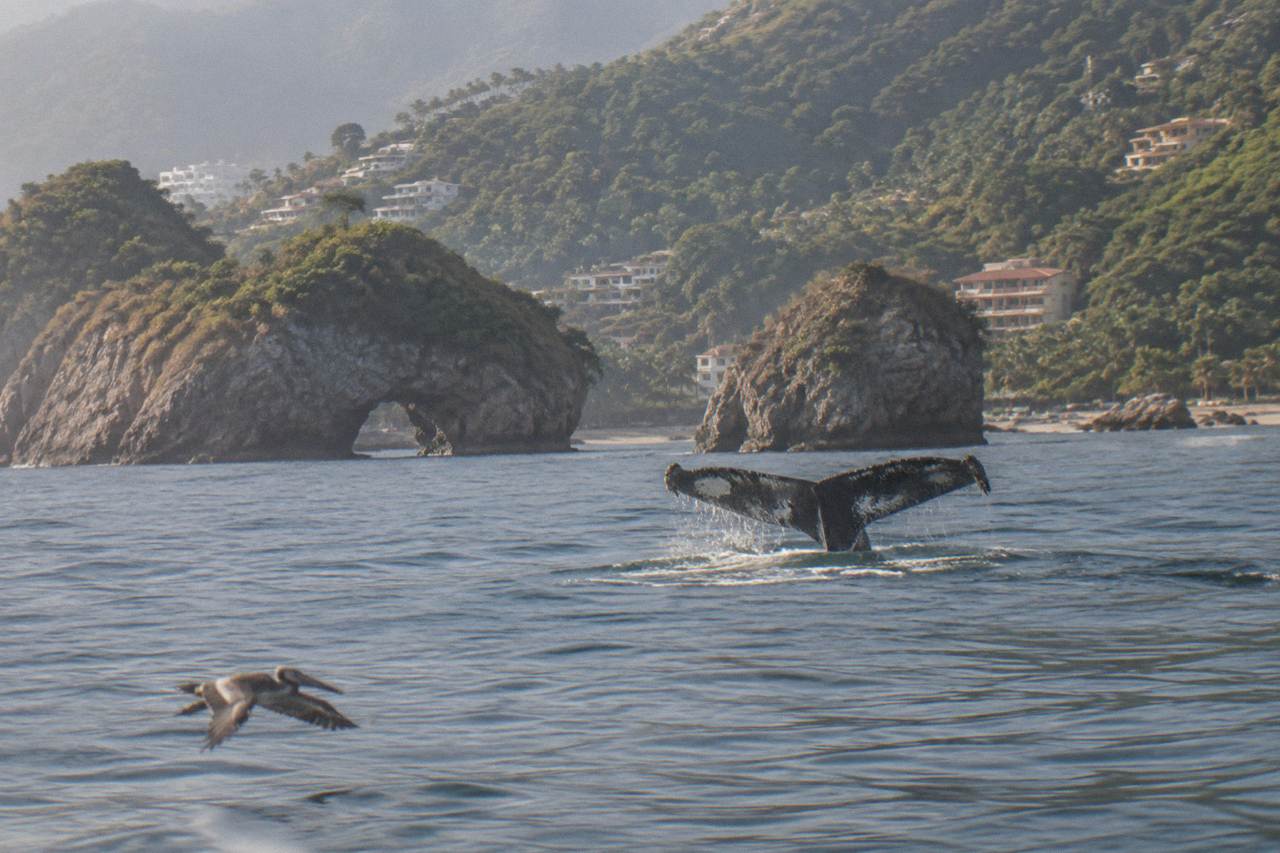
Every winter, roughly 500 humpbacks visit Banderas Bay, and every winter some travelers arrive hoping to slip over the side and join them. The intention is understandable. The answer, though, is a flat no, and it is worth understanding why before you book anything.
No tour on this site, and no licensed operator anywhere in Mexico, will take you swimming with humpback whales. The prohibition is federal, written into the official whale-watching standard, and it is enforced on the water. What exists instead is a set of legal alternatives that get you close to whales from a boat and, on some trips, into the water at a reef or beach stop far from the animals. Those are genuinely different experiences, and this page separates them clearly.
Can You Swim With Whales In Puerto Vallarta?
No. Swimming with whales is prohibited by law in all of Mexico, including Banderas Bay. Federal standard NOM-131-SEMARNAT-2010, numeral 4.19, bans swimming, diving, fishing and water skiing in whale observation areas, and no SEMARNAT-authorized operator may put a passenger in the water near a whale. Any tour advertising swim-with-whales in this bay is either operating illegally or misdescribing a reef snorkel stop.
The rule exists for the whales as much as for you. Humpbacks in Banderas Bay are mostly mothers traveling with newborn calves, and the bay's coastal strip between Punta Mita and the Rio Ameca mouth is formally designated a restricted zone during the season precisely because those mother-and-calf pairs concentrate there. A swimmer in the water near a calf is a stressor, an obstacle and a hazard at once, and a fully grown humpback can reach about 60 feet and about 40 tons. An accidental tail swipe from an animal that size is not survivable in any meaningful sense.
The restriction is not a gray area, either. The same federal standard that licenses the boats sets a minimum approach of 60 meters for small boats and 80 meters for larger ones, requires all vessels to wait at 240 meters, and caps any encounter with the same whale or group at 30 minutes. Authorized boats fly a numbered flag with the federal seal; unlicensed boats must stay 240 meters back. There is no distance at which a passenger is allowed in the water, and enforcement is real: PROFEPA, the federal environmental prosecutor, runs inspection operations through the season and boarded 17 vessels in one operation on the Nayarit side of the bay alone.
So the honest framing is this: watching humpbacks from a licensed boat is legal, popular and, by guest accounts, thrilling. Swimming with them is not an option anyone legitimate sells. If a listing you find elsewhere promises it, treat that promise as a reason to walk away, not a loophole.
What Federal Rule NOM-131 Actually Says
NOM-131-SEMARNAT-2010, published in the Diario Oficial de la Federacion in October 2011, is the binding national standard for whale watching in Mexican waters. Its numeral 4.19 lists prohibited activities outright: swimming, diving, fishing, water skiing and parasailing in observation areas, plus jet skis, kayaks, canoes, ultralights and helicopters for whale observation. Approach, speed and time limits apply on top of those bans.
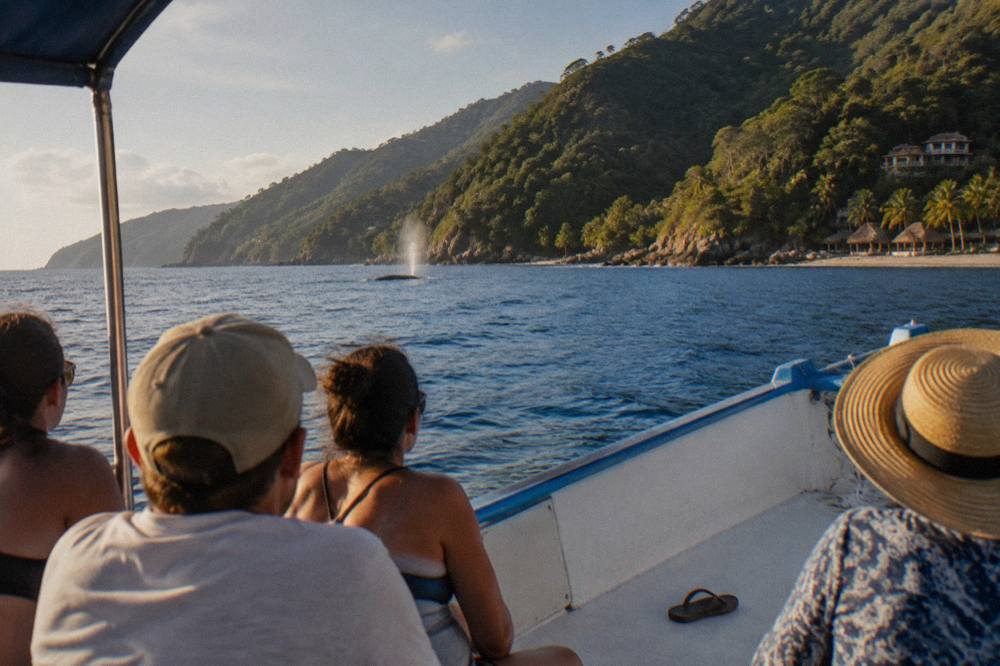
The full text of the standard is public and worth ten minutes if you are curious: it is published on the federal diary's NOM-131 page. The parts that matter to a traveler are easy to summarize. Boats approach no closer than 60 meters (small vessels) or 80 meters (medium and large vessels), never position themselves between a mother and calf, hold engines at idle when a whale is not moving, and stay below 5 knots, about 9 km/h, inside observation areas, dropping below 2 knots on the way in. At most four boats may gather around one whale or group, and the total visit is capped at 30 minutes.
One detail surprises people: the engine may be shut off specifically so passengers can listen through a hydrophone, an underwater microphone that picks up humpback song. Several tours on this roster carry one, including the biologist-led whale and dolphin boat from Opequimar and the Eco Explorer Vallarta whale encounter from Marina Vallarta. That is the sanctioned way to be inside the whales' acoustic world: the microphone goes in the water, you do not.
Each season also gets its own federal notice setting dates and restricted zones. The official 2025 to 2026 season for Banderas Bay ran 8 December to 23 March, set out in the SEMARNAT aviso published in the federal diary, which also bans whale watching within 1.5 km of the Islas Marietas and inside the 2 km coastal strip from Punta Mita to the Rio Ameca mouth. The notice for the 2026 to 2027 season has not been published yet; operators advertise the same 8 December opening, but treat that as operator scheduling rather than an official date.
Wondering whether a legal boat trip is worth the money before you commit?
Why The Search Term Swimming With Whales Mexico Misleads Travelers
Searches for swimming with whales mexico mostly surface two things: old blog posts about other countries and tour listings that quietly mean something else. In Mexico the activity is federally prohibited everywhere, so any page that seems to offer it here is describing either a reef snorkel stop on a whale tour or a whale-shark trip in a different part of the country. Whale sharks are fish, not whales, and they are a separate activity with separate rules.
The confusion is understandable, because a handful of destinations elsewhere do license cetacean swims under strict permits, and that content travels badly: a traveler reads about swimmers somewhere in the South Pacific, types the phrase with "Mexico" after it, and lands on tour pages that never quite say swim. Read the fine print on those pages and the water time, where it exists, is at a reef, a beach or with a different species entirely.
The other source of misleading copy is the combo tour itself. A "whale watching and snorkeling" listing sounds, at a glance, like it might put the two activities together. It does not, and legally cannot. The whale portion happens from the boat under NOM-131 approach rules; the snorkel portion happens at a reef or beach site chosen because whales are not around it. Operators are careful about this separation, and the better listings say so plainly.
This site keeps a wider rundown of the framework in its guide to Mexico's whale watching rules and distances, and the behavioral context behind the mother-and-calf protections is covered in the guide to humpback behavior in Banderas Bay. The short version: the law is protecting a nursery, and no tour has discretion over it.
What You Can Legally Do: Whale Watching Plus Snorkeling
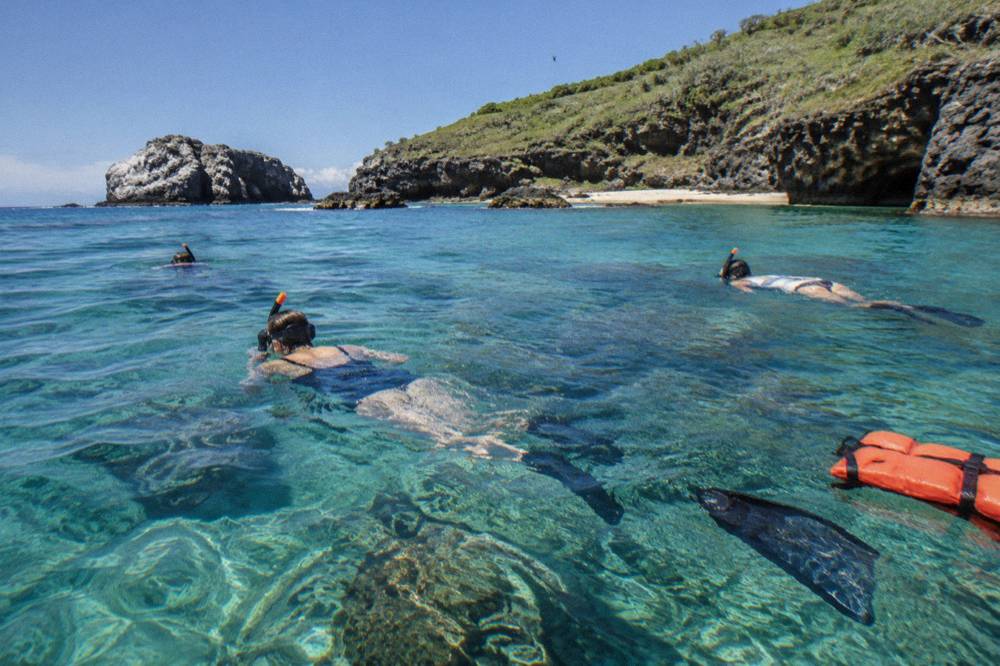
The legal way to get in the water is a combo tour: watch whales from the deck, then snorkel at a reef or beach site away from them. Both combos on this roster are honest about the split, from $42 per person for Travel vallarta, rated 3.9 from 65 reviews, to $85 for the Sayulita Entourage Marietas trip, rated 4.9 from 56 reviews.
Neither trip lets you near a whale in the water, and both structure the day so the two halves happen in different places. The Marietas Islands National Park combo departs from Sayulita, includes pickup, and runs about 5 hours, which is the longest day on this pairing because the park visit is part of it. Park rules matter here too: entry to the national park costs 125 MXN per person per day, children under 12 are exempt, life jackets are mandatory in the water, alcohol is banned inside the park, and access is only permitted with a CONANP-authorized operator, per the official CONANP park page. Remember also that whale watching is barred within 1.5 km of the islands, so the boat does its whale watching outside that radius.
Here is how the two legal combos compare, using only the figures each listing states:
| Listing | Operator | Price basis | Rating and reviews | Duration | Water time |
|---|---|---|---|---|---|
| Whale Watching and Snorkeling in Marietas Islands National Park | Sayulita Entourage | from $85 per person | 4.9 from 56 reviews | 5 hours | Reef snorkel stop, gear included |
| Puerto Vallarta: 3-Hour Whale Watching and Snorkeling | Travel vallarta | from $42 per person | 3.9 from 65 reviews | 3.5 hours | Snorkel stop, gear and life jackets included |
The price gap has a shape to it. The cheaper trip is shorter, departs from Los Peines marina on the Isla Iguana side, and lists a 39 MXN port tax on its inclusions; the Marietas trip is a full half-day with lunch, taxi transport and a national park visit folded in. If your priority is simply to be in the ocean on a day that also has whales, the budget option does that. If you want the islands themselves, the longer trip is the one that goes there, and the deeper comparison lives in the guide to Marietas Islands whale combo tours.
One boundary worth restating, because the marketing blur can blur it: none of these combos visits Hidden Beach, and whether that site is open, and under what conditions, changes with federal decisions. Rules and access shift; the operator confirms on the day, and no honest listing will promise you that beach.
The Closest Legal Experience To Being In The Water With Whales
The closest legal experience to being in the water with whales is an engine-off drift with humpback song playing live through a hydrophone as the whales surface around you, and The Whale Encounter Puerto Vallarta trip with Eco Explorer Vallarta, from $99 per person and rated 4.9 from 530 reviews, is built exactly around that: a small-group boat from Marina Vallarta with hydrophone, snacks, federal whale permits and conservation wristbands, no swimming required.
Guests who expected a swim and took a hydrophone trip instead consistently describe the substitution as better than expected. Watching a humpback breach from a deck is a whole-animal experience in a way no mask-level view could be, and the song through the speaker is something a swimmer would never hear clearly, since sound carries differently through hull, water and air. The listing for that trip is Short 3-Hour Whale Encounter if you want to see dates.
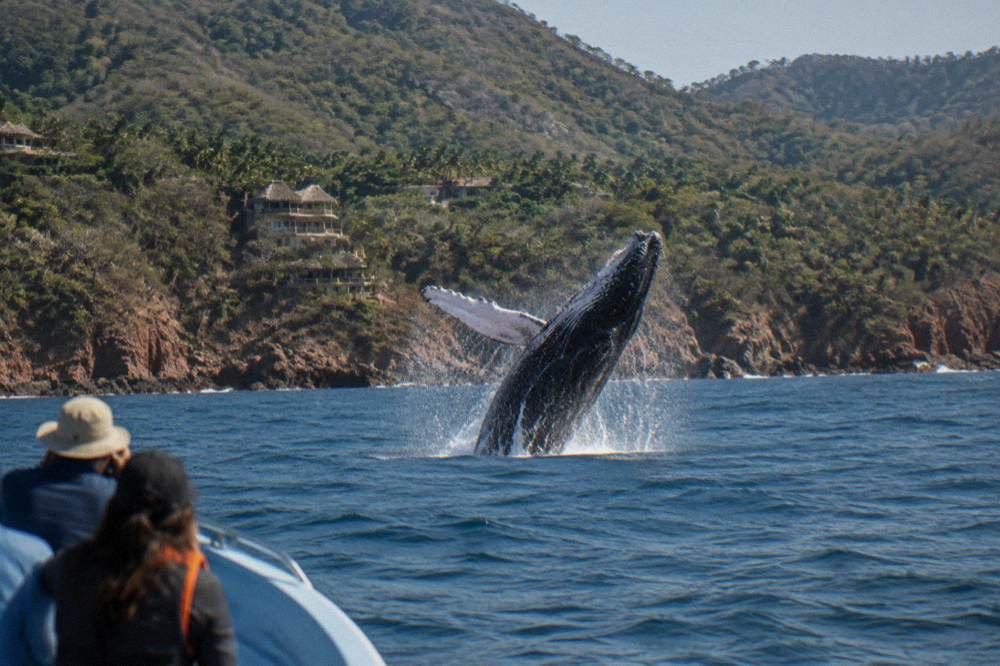
The decision logic is simple once the swim option is off the table. If you want the fullest on-water day, the whale-and-snorkel combos above give you two environments in one trip. If you want the deepest whale experience, pick the boat with the hydrophone and the biologist, because closeness here is measured in meters of legal approach distance and quality of interpretation, not in getting over the rail. Some travelers do both across a week, and the small-group half-day with lunch, from $110 per person and rated 5.0 from 353 reviews, is a common second booking once the first trip hooks them.
Whatever you choose, book a boat that names its federal authorization, carries the numbered flag, and states its approach behavior. That is the entire checklist for legal, low-impact whale watching in this bay, and Puerto Vallarta Whale Watching exists to keep that checklist easy to run.
A last practical note on timing. Humpbacks typically reach the bay in late November, according to hotel and operator guides, but commercial whale watching only opens with the official season, which last winter ran 8 December to 23 March. Operators advertise the same 8 December start for the coming season while the federal notice is still pending. January and February are the months operators name as peak, so if the whale half of any combo matters most to you, plan inside that window and check the live listing for the departure calendar.
Common Questions About Swimming With Whales In Puerto Vallarta
Can You Swim With Whales In Puerto Vallarta?
No. Federal standard NOM-131-SEMARNAT-2010 prohibits swimming, diving and snorkeling in whale observation areas throughout Mexico, and no SEMARNAT-authorized operator in Banderas Bay may put a passenger in the water near a whale. Every legal tour watches from the boat.
Is swimming with whales legal anywhere in Mexico?
No. The prohibition in NOM-131-SEMARNAT-2010 is national, not local to Banderas Bay. Tours elsewhere in Mexico that involve in-water time with large animals are whale-shark trips, and whale sharks are fish, not whales, governed by different rules.
Do whale and snorkel combo tours let you swim near the whales?
No. Combo tours such as the Sayulita Entourage Marietas trip and the Travel vallarta whale-and-snorkel trip watch whales from the boat, then snorkel at a reef or beach site away from whale observation areas. The two activities happen in different places by design and by law.
Can you snorkel at the Marietas Islands on a whale tour?
Yes, on a combo listing that states it. Entry to the national park costs 125 MXN per person per day, children under 12 are exempt, life jackets are mandatory in the water, and access is only allowed with a CONANP-permitted operator. Whale watching itself is barred within 1.5 km of the islands, so the boat watches whales outside that zone.
Why is swimming with humpbacks banned?
The ban protects both sides. Banderas Bay functions as a nursery in winter, with mothers and newborn calves in the coastal strip the government restricts, and a swimmer near a calf is a stressor and a collision risk. A humpback can reach about 60 feet and about 40 tons, and the species' Mexico population is listed as Threatened by NOAA.
What is the closest legal way to experience whales up close?
A small-group boat with a hydrophone. The engine is shut off, the underwater microphone goes in, and you hear humpback song live while the animals surface at their legal approach distance. The Eco Explorer Vallarta whale encounter and the biologist-led trips on this roster both carry hydrophones.